
In the open, $200–$500
A visible, reachable burst, garden, garage, accessible wall, cut out and repaired at business-hours rates.
Water finds the ceiling fast and the cause slowly, the wet patch is almost never over the split. We shut it down, trace the failure to its source, and repair the pipe rather than bandaging the symptom. Around the clock across Dee Why and the Northern Beaches.
Most of what bursts around Dee Why is age meeting pressure. Original copper lines from the mid-century build era wear thin from the inside until a pinhole opens; older galvanised steel rusts until a fitting lets go; and garden poly lines split where a root or a shovel found them years ago. Add mains pressure that runs high across parts of the Northern Beaches, and the weakest point eventually announces itself.
The catch is that water travels. It runs along the outside of the pipe, along joists and wall plates, and surfaces somewhere downhill of the actual split, which is why the wet patch on the ceiling is so often metres from the leak. Repairing where the water shows up fixes nothing. We trace the line back to the failure itself, repair that, and pressure-test before closing anything back up.


Dee Why (postcode 2099) is the busy heart of Sydney’s Northern Beaches, running from Dee Why Lagoon and the beachfront Strand back up Pittwater Road toward Narraweena, Cromer and Collaroy. Its mix of 1960s red-brick walk-ups and new apartments keeps thousands of people on ageing shared drains, and keeps local plumbers busy.
Houses plumbed from the late fifties onward largely used copper, which lasts well, often better than the fittings joining it. Compression joints and early soldered connections are usually where a seventy-year-old copper system gives way.
That is good news. Copper in sound condition with one failed joint is a small repair, and there is no case for replacing a system that is doing its job.
The cafes and restaurants along The Strand and Oaks Avenue push serious volumes of fat and food waste, which congeals in shared lines behind the shops.
The line is broadly the same as for drains: pipework serving only your lot is yours, and anything serving the building, risers, mains, common-property pipework, belongs to the owners corporation.
Where it gets argued is damage. A common-property pipe that damages your contents usually engages two policies, and the way to keep that simple is contemporaneous evidence. We document time, source and cause on the night for exactly that reason.
They can look identical from inside the house: water where it should not be, and a fixture behaving badly. The quick test is whether the water is clean and continuous, or dirty and rising when something is used.
Older walk-ups off Pittwater Road still drain through original cast-iron and clay stacks; decades of scale and grease narrow them until one flush too many blocks the whole riser.
Clean water appearing with no fixture running is a pressure pipe. Dirty water rising when you flush or drain something is the sewer. Tell us which on the phone, it decides what comes off the van and whether you should be isolating the water at all.
Homes of this period were built to be lived in rather than serviced. Pipework runs under floors with limited crawl space, through fibro sheeting that does not like being cut, and into slabs poured before anyone thought about access.
It is why locating a leak precisely matters more here than in a modern home, the cost difference between opening one square metre and opening a room is most of the invoice.
In an apartment you generally cannot use the street meter, that serves the whole building. What you need is your lot's own isolation valve, usually in the laundry, a hallway cupboard, or a riser cupboard on your floor.
Find it on a calm evening and make sure it turns. A valve that has not moved in fifteen years sometimes will not, and discovering that at midnight with water running is a much worse time to learn it.
When an area went up as a single wave of building, its plumbing reaches the end of its life as a single wave too. Neighbours comparing notes about bursts in the same season are not imagining the pattern.
If houses either side of you have had pipework replaced, that is genuinely useful information about yours. It does not mean acting immediately, it means a burst in your house is a condition report rather than a surprise.
A visible, reachable burst, garden, garage, accessible wall, cut out and repaired at business-hours rates.
Adds the tracing and the careful access: finding the true split before opening anything, so only one hole gets made.
Detection gear, concrete access or a reroute. Precision here is the whole cost battle, small hole, right place.
Roughly $180–$250/hr against $120–$160 daytime, plus call-out. With the meter off, morning is sometimes the smarter spend, we will tell you honestly.
Leak detection's first hour, locating the failure before demolition, reliably cheaper than exploratory holes.
Every repair ends the same way: holding mains pressure on a gauge, under a lifetime workmanship warranty. Figures here are indicative of the 2026 Sydney market rather than a quote from us, you get your own number as a fixed price before any work starts.
On the phone: meter valve, clockwise, done: the flooding stops before we have left the depot. On site, we isolate just the affected line where possible so the rest of the house stays on.
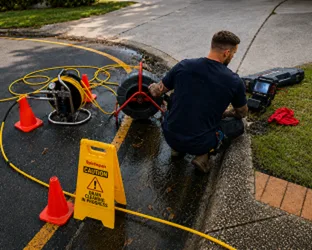
Water surfaces downhill of the failure, so we trace: acoustic gear, thermal imaging or pressure testing for concealed lines, before anything is opened up.

The failed section is cut out and replaced, not bandaged. If what we expose says the whole run is at end of life, you get that assessment straight, with numbers for both paths.

Pressure-tested against the mains before any wall, floor or trench is closed. You see it holding before we leave.
The hard part is done, the water has stopped. Call, and we plan the repair with you before anything else gets wet.
Water off? Good: now let us get it back on. Fixed price before the repair starts, pressure-tested before we leave.

Leave your details and our local Dee Why team will call you back fast.